Research and teaching
📄 Research
Voluntary blood donors enable millions of transfusions every year, helping strangers to live longer and better. My research aims to understand how we can support donor health while sustaining blood supplies. I use primarily quantitative methods and collaborate with colleagues in transfusion medicine, biostatistics, psychology, and health economics.
Publications
- Wu Y, Di Angelantonio E, Kaptoge S, Wood AM, Gilchrist PT, Walker M, Kingston N, Masser B, Roberts D, Ferguson E, Kim LG. Role of pain and anxiety in mediating relationships between donation history and vasovagal reaction symptoms in blood donors in England. Transfusion. 2025 Nov 21. doi: 10.1111/trf.70004.
- Wu Y, Qi H, Di Angelantonio E, Kaptoge S, Wood AM, Kim LG. Risk factors for vasovagal reactions in blood donors: A systematic review and meta-analysis. Transfusion. 2025 Jan;65(1):211-223. doi: 10.1111/trf.18078.
Invited talks
- Wu Y, "Vasovagal reactions in blood donors - risk factors, mechanisms, and prevention". German Society for Transfusion Medicine and Immunohematology meeting (2025).
- Wu Y, "Impact of personalised collection volumes on donor safety and donation efficiency in England: a simulation study”. University of Nottingham School of Psychology People and Society Research Group seminar series (2026).
Oral presentations
- Wu Y, "Blood donation frequency and cardiovascular disease risk in England: 10-year follow-up of the INTERVAL trial". European Conference on Donor Health and Management (2025).
- Wu Y, "Could psychologic constructs explain why inexperienced blood donors are more likely to faint?". Cambridge Public Health early career researcher networking event (2024).
Poster presentations
- Wu Y, "Donation history and vasovagal reactions in English whole blood donors: associations and mechanisms". British Blood Transfusion Society meeting (2024). Poster link.
- Wu Y, "Across 73 studies of 19 million donations, blood donors who felt faint were often younger, inexperienced, smaller, hypotensive, female, and fearful of donation". Royal Papworth Hospital Celebration of Research event (2024). Poster link.
📚 Teaching
Undergraduate courses
I currently supervise first-year medical students in Foundations of Evidence-Based Practice. In Cambridge, supervisions are small-group teaching sessions where learners discuss lecture content and its real-world applications with someone already working in their field of study.
Postgraduate courses
I am serving/have served as a course supervisor (~16 hours), teaching assistant (~12 hours) and exam grader (~12 hours) for statistics and epidemiology modules within the MPhil in Population Health Sciences at the University of Cambridge. I have also assisted with the design of assessment materials for an advanced biostatistics module within the MPhil.
📝 Service
Peer review
I have reviewed for:
Departmental committees
I helped to organise my research unit's annual away day in 2024 and 2026. From 2025-2026, I served as the co-chair of my department's PhD student committee.
Improving blood service communications
I periodically suggest changes to the English blood service's donor-facing communications materials to improve their clarity and readability from dual donor and researcher perspectives. You can read about the resulting changes here. I have also suggested changes to the structure of the Indian Red Cross Society's blood donation webpage, some of which have been implemented! Here are the previous and updated versions of the webpage.
Miscellaneous
Seeing that a colleague from the Belgian Red Cross, Dr Hans Van Remoortel, had lost his poster en route to an international blood transfusion conference, I created the below simple sketch of the poster, which was subsequently displayed on an A4 sheet of paper during the conference!
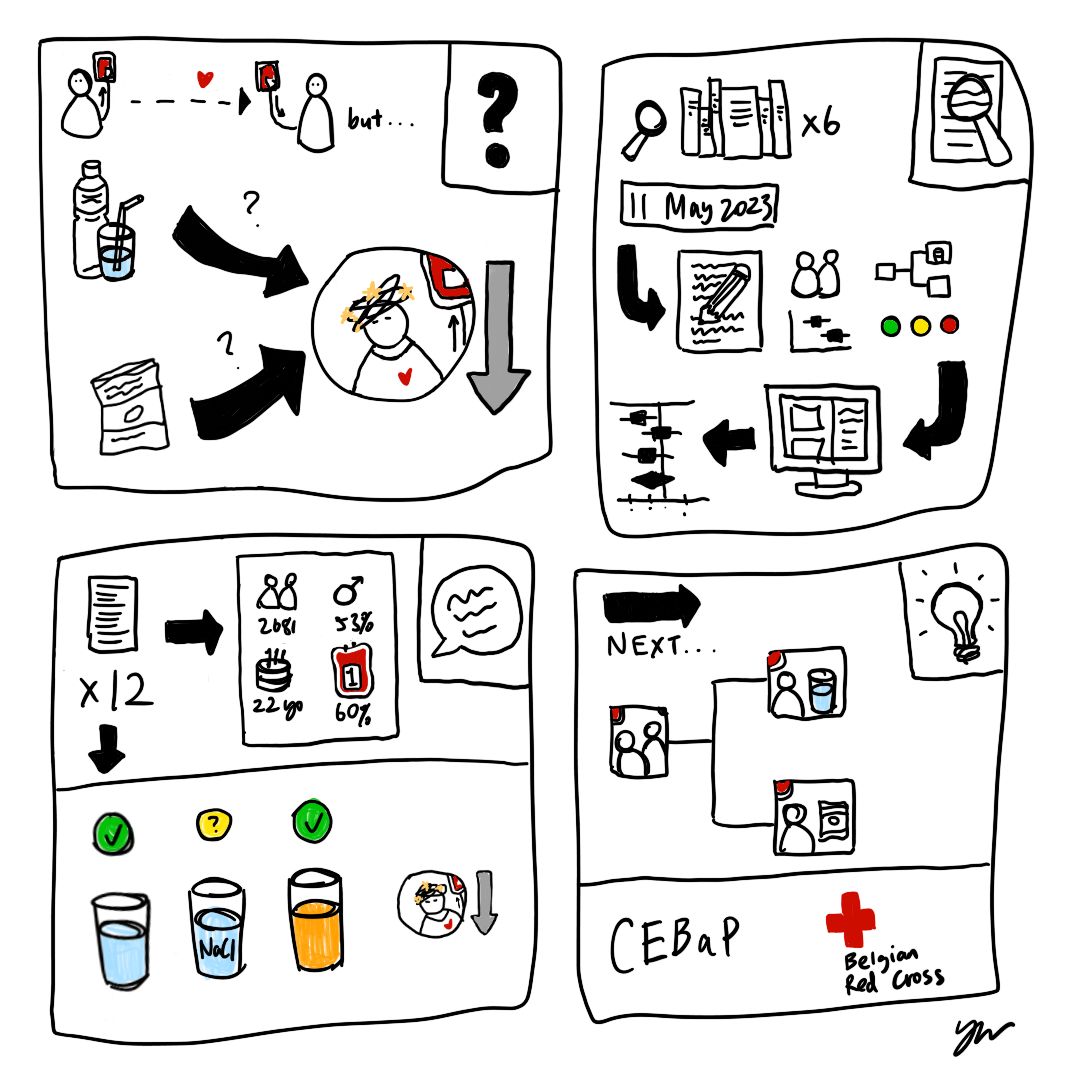
Original poster courtesy of Dr Hans Van Remoortel and colleagues.
👥 Public engagement
Festivals, open days, and dialogues
I recently organised a full-day activity (see here) for the 2025 iteration of the Cambridge Festival, a multi-day event that invites local publics to engage with university-hosted research. I previously organised (see here) and volunteered for three activities during the 2024 iteration of the same festival. I have also volunteered at 2024 and 2025 editions of the local charity Abbey People's Eager Explorers event, during which I conversed about our unit's research with children and families. Finally, I have volunteered at 2024 and 2025 editions of the "Hopes and Fears Lab" run by the Kavli Centre for Ethics, Science, and the Public, which involved conversing with local publics about their hopes and fears about the future of science and technology over an iftar meal.
Schools and young people
I currently volunteer with I'm a Scientist, which gives me the chance to chat with primary and secondary school students about careers in science. During my PhD, I served as a Student Ambassador for my college, Trinity Hall, which allowed me to give tours and Q&As to prospective students from diverse socioeconomic and geographic backgrounds.
Science communication
I was a 2024 East of England finalist for Famelab, a science communication competition that invites early-career researchers to speak for three minutes about their research to diverse audiences.